TWO HOURS WITH TIM & ERIC
In January 2024, for the first time I spoke to two of my spiritual fathers, Tim Heidecker and Eric Wareheim, about their cultural influence and clairvoyance. Part One of many parts to come.

[Dear reader, a brief essay follows this piece of interview.]
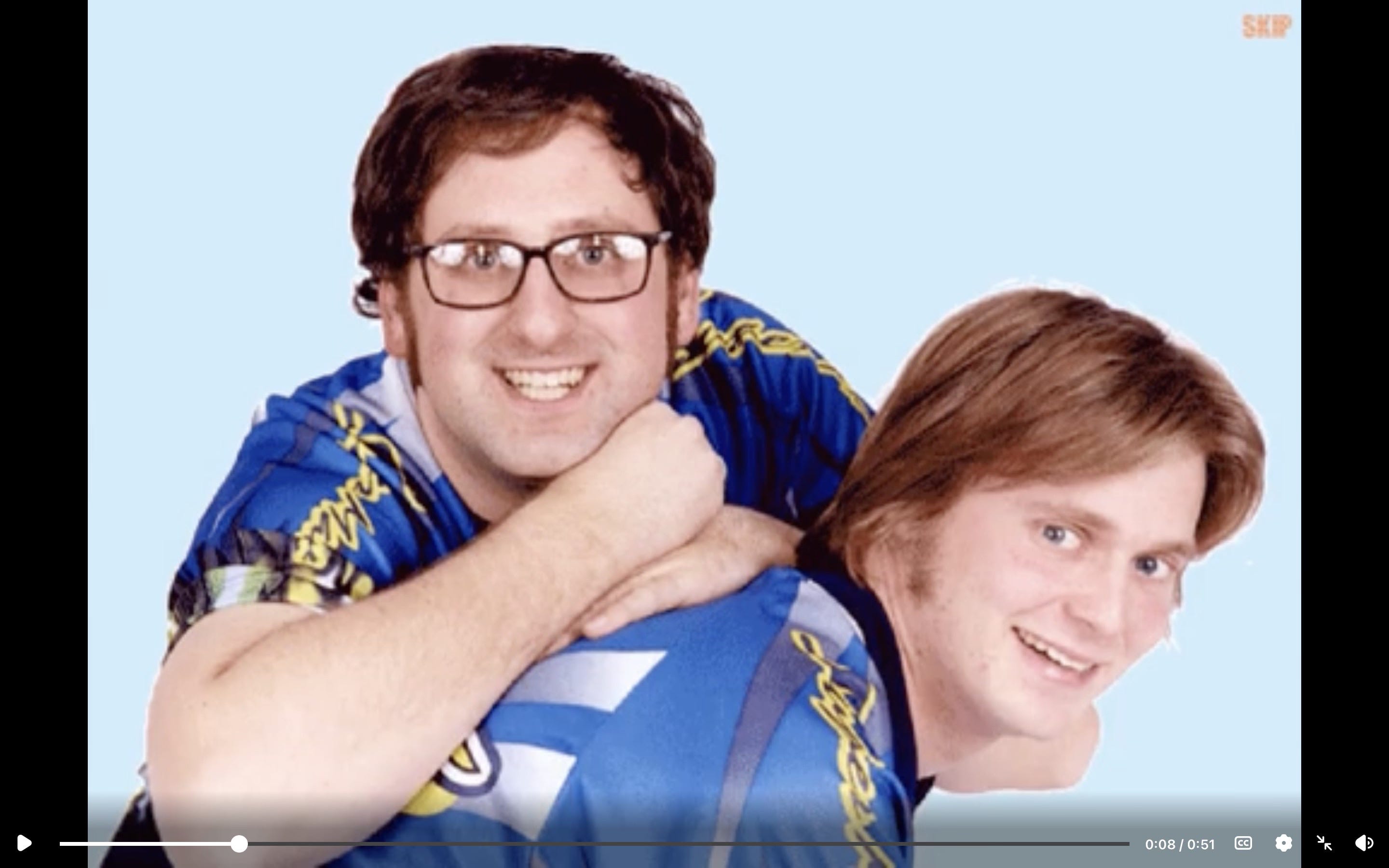
Charlie H. Stern: Hi guys. You are my dads. You raised me. You literally raised me.
Tim Heidecker: We’re very proud of you.
CHS: You guys have been around for decades. The contemporary comedy and social media mores and memes and zeitgeist really borrow from you in ways that people don’t know or don’t understand, or at least they are not aware of where these things started.
So the seed of this pitch was the in-world linguistics of Tim & Eric and the influence on linguistics of today. Internet animal memes used to be like, “I can haz,” “I can haz cheeseburger,” but now I’ve been noticing that everything is Dr. Steve Brule speak. So everything is like “bingus,” “chungus,” “scrunkly,” “scrungly,” etc., and these are also mostly used to describe animals, especially cats. So I wanted to hear the inspiration behind the original in-world linguistics. And then I also have input to share with you from a linguist who explained to me why those sounds are so pleasing.
TH: Oh yeah.
Eric Wareheim: This is the best already. “Dangus,” “sprungus.” Well, before Brule, we just loved wordplay. I mean, just that kind of sing-songy “yum yum” or “chip chip.”
TH: [simultaneously] “Chippy.”
EW: And we had heard it from different languages or people trying to speak English, or signage. There’s a restaurant in San Francisco called Yummy Yummy. That’s just funny. But then for Brule, a lot was him. He had his voice, and I think between his natural ability, and Tim and I writing some of it, you know, throwing stuff out, we found that rhythm.
TH: From having been on other projects that are Tim and Eric projects, and in comparison to how the machine of production, writing, and comedy works elsewhere, we didn’t know any of that stuff, so when we were doing it, I think what you guys are all seeing was literally us just trying to make each other laugh.
And I think that is what John is doing when he’s doing Brule is trying to make us laugh, and he’s trying to make the camera guy laugh. I’m trying to make Eric laugh. He’s trying to make me laugh. That breaks through into making you guys laugh, but it doesn’t always work that way.
When you do other things, it feels like you’re kind of a slave to the script and you’re a slave to the production and to the writers. What they’ve already worked out is what they think is funny, and you’re just trying to execute that. But what you guys are seeing with Dr. Steve Brule is saying something really incongruous and it doesn’t make any sense why you’d say that to somebody else. He’s doing it to make us laugh because it’s recreational fun, you know?
CHS: Yes. And a lot of why people want to repeat that language is the very basic mechanics of echolalia. That’s probably what you guys were doing to each other, right? Kind of going through and circularly communicating with each other in sounds?
EW: Yeah. Even with characters like Richard Dunne. He would say things like “rip,” “dip.”
TH: “Clipped.”
EW: With Brule and us, you can’t just live in that world of echolalia. Love that word. But you have to pace it out. Brule works because he’s really interviewing a real person, and then all of a sudden, there’ll be something like a “dingus” or “bungus.” That’s when it hits.
TH: What also makes that work is the Brule syntax. There’s some kind of structure -- There’s logic to it, and there is some kind consistency within it, in his brain.
CHS: So, in-world, is he just super nervous or is he very, very stupid?
TH: You know, it doesn’t really matter. You notice that there has been a downgrade of mental acuity throughout the years. That goes back to us getting bored with certain things and experimenting and pushing it further and John trying to make us laugh, us trying to make him laugh.
That’s what the core of it is. It’s not really a logic issue about, “Who is this? Where does this person’s IQ lie?” It’s about what captures the emotional and comedic moment best.
A good example of that would be him doing the job interview and not being able to write. Yeah, like, that’s an absurd moment. It’s not really based on any kind of logical reality. It’s more about playing into the emotion of his relationship with that woman, as in, how embarrassing that would be or how pathetic he is. We were aiming to get to the core of what would be the funniest, most impactful way to show that.
CHS: So I’ve noticed usage of this language as widespread memes online, along the lines of “bingus” and “chungus” and other off-shoots. Do you know about Glup Shitto? Okay, so there are like too many Star Wars things. There are too many Star Wars projects. And so people started making fun of the series on Disney Plus and started saying “Oh, I hope Glup Shitto shows up” to make fun of the in-world linguistics of that universe. So it was explained to me by a linguist and educator I know* that the way Brule-speak works and the way language like this has endured and spread and is infinitely buildable is that it’s a lot of the same powerful consonants, in valor stops, alveo-palatal affricate, and higher form-to-sound correspondence. There are rules to this language and people can take those and invent more, like a cat being scrungly, and everyone knows what “scrungly” is. This is what originally started my need to talk to you guys.
EW: Scrungly. I love that.
CHS: Yeah, cats are scrungly.
EW: I don’t know if you know this, but is there a Brule lexicon up online? I wonder if someone wrote down all the highlights. It would be funny to see that.
CHS: There is a fan-driven Wikipedia, and it lists all the Brule’s Rules but not the linguistic rules. That would be so fascinating, to have an actual linguist really break it down, because he’s just slipping and sliding. He’s like a car on ice.
EW: What’s interesting about “scrungly” is that it works to me, and that made it through, but often people try to do Brule and it’s cringe because you’re like, “No, no, there’s an art to the thing.” But it’s interesting that it’s gotten to a place where some of these rules can exist and it works.
CHS: Yeah. Something is going to sound wrong because it is against the comedic rules of this language. The linguist I spoke to listed a bunch of different echolalia memes like “Horse Plinko,” “blorbo from my shows,” “eeby deeby,” “Glup Shitto,” and they’re all echolalia memes that have been circulating around the contemporary internet.
EW: I don’t know if this relates, but a lot of the names that we came up with also have that feeling, like Dobo or Mobin.
TH: Chrimbus.
EW: We couldn’t name someone Bob. The names can sound a little Eastern European, but we’re somewhat inspired by that.
CHS: Is that ancestry that you guys have, Eastern European?
EW: I do. My mom’s first generation German and her family’s from Czechoslovakia. So we have some very interesting names like going back. And the people that we would hire as actors were not your regular kind of white Americans. They were from all over, and some had great names. Some we would keep, like Ben Hur.
CHS: So how much do you guys interact with social media? I know you guys are on social media, but there are certain celebrities who don’t engage. They schedule posts or hand off their social media to management.
TH: Good for them!
CHS: Tim, I wonder, are you limiting your children’s interactions with social media?
TH: Well, yeah, they’re not on social media at all yet. I don’t think I’ll be too strict. I want them to be aware that this is the world, so I’m sure there’ll be a point where they’re online. They’re on YouTube a lot.
EW: What’s online?
TH: Online.
EW: Online.
TH: On the internet in general. I kind of got off Twitter and made that a joke to have somebody else running it.
EW: Are you really? You’re OFF off?
TH: Yeah, I mean I look. I look. But it’s dead. So it’s like visiting an old ghost town. I do my best to not stay on it all the time, but I can’t say I’m off it. No.
To be continued…
—-
*BACKGROUND ON LINGUISTICS FROM DAISY ZIA FATEMI:
Phonologically, it is interesting how they repeat a lot of the same consonants (/g/ and /k/ which are velar stops, and /ʤ/ which is an alveo-palatal affricate) and mostly use what’s perhaps the most common English vowel /ə/ (the “uh” sound). A possible reason they’ve spread so much is that those sounds generally have a much higher form-to-sound correspondence than most English sounds, that is, it’s really easy to transcribe the sounds into words that are spelled “correctly,” and it’s easy to pronounce those words “correctly.”
The velar stops are voiced-voiceless pairs, and there’s also the voiceless alveo-palatal affricate /ʧ/ (the “ch” sound) which forms that same kind of pair with /ʤ/ (the “j” sound). In terms of stress, a lot of these are basically trochees (a stressed-unstressed syllable pair) which English speakers really like.
You might also be able to draw connections to what have been occasionally termed the “echolalia memes” on tumblr, which are “Horse Plinko”, “blorbo from my shows”, “eeby deeby”, and “Glup Shitto.” These were memes on tumblr popularized from late 2020 to early 2022. They’re mostly nonce words that just sound funny and thus get repeated ceaselessly. Like most modern tumblr memes, they were slow burns and still haven’t really died out, due to the unique ecosystem now found there.
“Horse plinko” refers to a gif of a 3D horse falling while hitting regularly-spaced tines, as if it was the ball in a Plinko machine. It’s nonsense, but the good folks at tumblr are nothing if not good at repeating funny phrases and reblogging surreal gifs.
“Blorbo from my shows,” later shortened to simply “blorbo,” refers to a character from a piece of media that the person speaking (the referent of the pronoun “my”) is obsessed with. You can have blorbos from TV shows, yes, but from movies or books or video games as well. It’s given us one of the most well-integrated pieces of vocabulary on tumblr out of any of these memes, as evidenced by it losing its prepositional phrase (“from my shows”) and able to be pluralized (“blorbos”). The exact etymology of the word “blorbo” is unknown to me, though a screenshot exists of its very first usage.
“Eeby deeby” is an older one, but it got big on tumblr after an elevator display was made to read “eeby deeby” instead of “floor 2” or anything else. Again, the funny phonetics won over the general userbase, and the phrase was repeated with or without any sort of context for quite a while.
“Glup Shitto” specifically refers to a nonexistent generic Star Wars character. The term was coined to poke fun at the increasingly long list of characters and their names that has come with each new release of Star Wars media. “Scrimblo Bimblo” is a similar generic name for any new and obscure addition to Super Smash Bros games.
I don’t know if these terms were coined specifically *because* of how they sound, or if the way they sound is what propelled them to virality, but it’s interesting to know about them nonetheless. I think they were dubbed “echolalia memes” perhaps because the way they sound indeed may have been what popularized them. I can definitely speak to their tendency to lodge themselves firmly in my auditory memory, to the point where I’ll just say them over and over again just for shits and giggles.